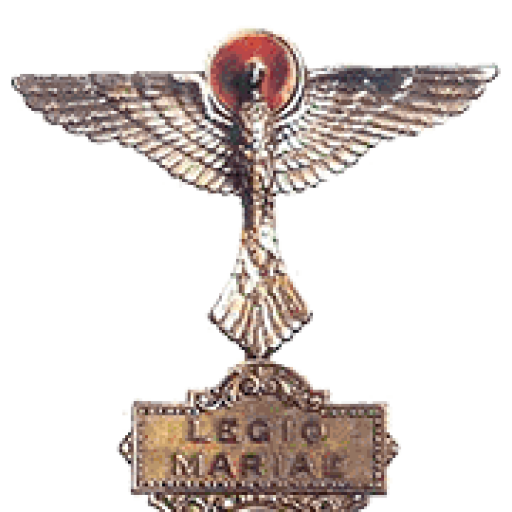
The Origin and Development of the Legion of Mary in Scotland by Anne McGurran
At the end of 1927 Mr. Duff came to Scotland in the hope of setting up a foundation of the Legion of Mary. Archbishop Mackintosh (Glasgow) gave him permission to go ahead. Approaches were also made—successfully—in Edinburgh, Dundee and Aberdeen.
So, too, took place in St. Peter’s, Partick, on the 26th April, 1928, the first Meeting of the Legion of Our Lady of Lourdes. It was known as the “Patronage” of Our Lady of Lourdes. In May, 1928, a week later, the second Praesidium, Our Lady of the Immaculate Conception, was set up in St. Aloysius Jesuit Church, Garnethill. Later, a third was set up in Larkhall, Lanarkshire.
These Praesidia were engaged in visitation of Catholic homes, running of Girls’ Guilds, visitation of mental, maternity, and cancer hospitals.
First experiences of home visitation were a real ordeal, for me personally. I was taken into a school and was well known to parents and children. Imagine then on a beautiful spring evening when the children and their mothers were playing in the streets or sitting at the “close mouth,” another Legionary and myself appearing and going up and down the “closes” looking for Catholics. Soon we had a string of children following us—calling out, “Hey, Miss, who are you looking for?” By the time we had finished the Pied Piper had nothing on us! Soon we regarded visitation as ordinary Legion work. We ran a social for three of the poorer streets in the parish. It was a great success. A community spirit was being established.
In June we learnt that a start had been made in the Cathedral Parish, Aberdeen.
In November, 1928, the first Curia Meeting took place in St. Peter’s, Partick, with representatives from Our Lady of Lourdes (St. Peter’s), Our Lady of the Immaculate Conception, Garnethill, and Our Lady of Lourdes, Larkhall. Mr. Duff came over for this meeting and gave a talk on the nature and object of a Curia.
In January, 1929, we were asked by Dublin to contact the Praesidia in Edinburgh, Dundee and Aberdeen.
A year later, armed with a letter from Archbishop Mackintosh giving the Legion his blessing and good wishes, we approached the parish priests in Glasgow. A number of them asked for time to consider the matter. In April of that year, through Concilium visitors, we heard of the progress of the Legion in Edinburgh, and later on we were to visit them regularly.
In the following months, four more Praesidia were set up in various parishes of Glasgow. Carfin, Stirling and Saltcoats were also added to the list of Praesidia. The Legion of Mary was indeed growing.
A report from St. Mary’s, Glasgow, showed that amongst their works was the visitation of a model lodging house. Later other Praesidia in the east end of the city were also to undertake this work. But other works were developing: attention was drawn by Father Agius of St. Aloysius’, Garnethill, to the need for Catholic Clinics in the city, and the “Institutum Deiparae” was established in Garnethill to supply doctors and nurses to protect young Catholic mothers from the enticements of non-Catholic clinics. Mr. Duff, in a letter, suggested the adoption of the Catholic clinics as a Legion work, and the Praesidium, “Our Lady Expectant,” was set up to run this work. Two clinics, one in Cowcaddens and the other in Govan, were established. Legionaries visited the patients; went round doctors and chemists; and collected medicines, chemical foods, bandages, etc. This work continued until the need for it ceased.
At the same time, a club for domestics was run by the Praesidium “Handmaid of the Lord.” Hotels, nursing homes, private houses, etc., were visited and Catholic domestics invited to come along.
Mention has already been made of visitation by Praesidia of model lodging houses. In 1932, to co-ordinate this work, “Our Lady of Reconciliation” was set up. No one to-day can realise the terrible conditions then existing in these places, which included about seven for women. Permission was sought and obtained from Archbishop Mackintosh for the setting up of a Women’s Hostel.
In August, 1932, was established the first men’s Praesidium, “Our Lady of the Wayside.” Their work was visitation of the men’s lodging houses. A social club was set up. The Praesidium is still doing excellent work in the city.
By December, 1932, eighteen Praesidia—fourteen in Glasgow, one in Lanarkshire, one in Ayrshire (Saltcoats), one in Greenock, and one in Stepps—had been attached to the Glasgow Curia. Mr. Duff then suggested the setting up of junior Praesidia, the first of which was set up in Riddrie. Now, 180 junior Praesidia are to be found attached to senior Praesidia, and in a few schools.
“Regina Coeli” Praesidium was set up in September, 1934, to work towards the establishment of a hostel for materially destitute women. The late Monsignor Canon Taylor, Carfin, gave the first donation towards it. In the meantime, lodging house visitation was developing. Each Christmas Eve the sisters collected the women and accompanied them to Confession and then each Christmas morning they accompanied them to Mass. A special Christmas breakfast was provided, all the items on the menu having been donated by good friends. On one occasion what seemed a miracle took place. Breakfast over, the Legionaries were cleaning up when suddenly a sister appeared with two more women. There was consternation on the part of the sister who was cooking the breakfast, for although there was enough ham for two there was only one egg. With a prayer on her lips, she fried the bacon and then broke the egg—behold, a double yolk!
In August 1934, it was announced that Rev. Father O’Brien had donated £1,000 from the O’Brien Trust Fund towards a Regina Coeli Hostel. Here tribute must be paid to the late John J. Campbell for all the help he gave the Legion then, in trying to find a place for the Hostel and afterwards. In the meantime (October 1935) a Social Parlour was opened for six nights in the week to provide entertainment (singing, dancing, games, etc.) for the women of the lodging houses. Later, the brothers, not to be outdone, rented an old shop as a social club for men.
Then came the big event. In October, 1935, premises were purchased at 8 Park Circus Place, and on the 11th February, 1936, Regina Coeli Hostel was opened. Those were two gala nights in the history of the Legion, when priests and Legionaries from all over Scotland and England, Concilium Officers, Mr. Duff and Sr. Mortell, members of the Corporation, and prominent lay people attended the opening celebrations.
During the succeeding years many destitute women availed themselves of the Hostel. These were not easy times, for we had to contend day and night with drunken women, but they were happy times. We knew we were helping them because they were going regularly to the Sacraments. We had an Oratory in the Hostel and at certain times we were privileged to have Mass.
One of our residents was an ex-teacher, Mary. One Saturday night when another Legionary and myself were on duty there was a knock at the door and a young woman announced, “I think one of your women is down the street.” The two of us went down the street (Park Circus Place and district was a very superior quarter in those days; indeed, I often marvelled at the forbearance shown when our women were bawling their heads off). We were wearing our blue overalls. There lay Mary spread-eagled, dead to the world, with a crowd round her. We went forward to help her up when one of the bystanders enquired, “Does your mistress often take these turns?” I told a real whopper when I said, “Not often”! For the first few years she stayed with us it was a daily occurrence. Later, Mary gave up drinking altogether and died a very holy and happy death. The sisters attended her funeral as she had no relatives.
Later, we were allowed to have a limited number of unmarried mothers and their babies: and I who hadn’t a scrap of experience of babies, became the proud possessor of a certificate which hung in the front hall, stating that I was the Matron of a Maternity Home! Later, when the Hostel closed with the advent of the Welfare State, I had to hand it back.
In the same year “Sancta Maria” Praesidium was set up. It was hoped to provide a Hostel for the street girls.
In June, 1937, Glasgow Curia was raised to the status of Senatus of Scotland.
The same generous donor provided £500 and in October, 1937, Sancta Maria Hostel was opened. 1938 saw “Our Lady of Light” Praesidium set up for the visitation of women prisoners in Duke Street Prison. Later this prison was transferred to Gateside, Greenock, which is still visited by the members of this Praesidium, entailing after-care work. Men prisoners in Barlinnie are visited by the brothers.
Although I am stressing these special works of the Legion, it should be remembered that the ordinary parochial work was continuing.
During the war years the Legion carried on, undaunted by darkened streets, uncertain transport and the risk of a bomb exploding in front of you at any minute. 1939 to 1945 represented the high-water mark of Legion extension in Scotland. In Galloway, Stranraer, Kirkcudbright, Annan, Garelochhead, Oban, Praesidia were set up, while in Stirlingshire and Ayrshire R.A.F. Praesidia were established, with one for Polish sailors of the H.M.S. Doonfoot, Ayr. One recruit made during that time was a captain in the R.A.S.C. stationed in Maryhill Barracks. He joined the Wayside Club, and did much valuable work. The war years also saw the start of the two Seminary Praesidia in Bearsden with the late Mgr. Treanor as Spiritual Director. During all these trying days the link between the Senatus and Curiae and Praesidia was maintained.
After the war, consolidation and development took place. Home visitation was extended to include non-Catholics, and in 1954 “Queen of Scotland” Praesidium was set up to concentrate on this work. Monthly Days of Recollection, Series of Talks in local halls, Outings to places of Catholic interest such as Nunraw, were all introduced for interested non-Catholics. The Pauline Committee was set up to co-ordinate the work in the various Curiae. With an eye to the future, we concentrated on the development of Junior Praesidia. An apostolate of the films; a Deaf and Dumb Praesidium; a Praesidium, “Our Lady of Nazareth,” for housewives, with a meeting in the afternoon; a Praesidium for Trade Union Members as well as a Gaelic-speaking Praesidium (an important one in these days of Peregrinatio to the Highlands and Islands).
 The Legion of Mary Scotland